DISTRIBUTOR-FIRST SUPPLY PARTNER · SINCE 1999 Live · Pneumatic Automation System

SPC Company
Pneumatic Automation / Control & Valving / Silencers / Sintered Bronze Muffler
Layer 03 · Control & Valving Performance · KELTEC Value · Allied Witan Price · Adsens
What it is

Sintered Bronze Muffler

Compare tiers ↓

A sintered bronze muffler threads into a valve or cylinder exhaust port and quiets the sharp blast of air released each time the valve shifts. Its working element is a porous bronze body, made by compacting and heat-fusing bronze powder so the finished part is shot through with fine interconnected passages. Exhaust air takes the place of one loud jet and instead diffuses out across thousands of those tiny passages at low velocity, dropping the noise into the OSHA-acceptable range. The bronze element is also a coarse filter; it keeps shop debris from being drawn back into the exhaust port. Bronze is the durable workhorse of the muffler family and the default for general industrial duty: the metal element resists mechanical damage, handles heat, and tolerates the oil mist and dust of a typical plant, though it is exactly that dust and oil that eventually clogs it and drives replacement.
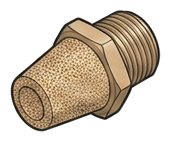
Pictorial Representative sintered bronze muffler
Sintered Bronze Muffler — representative illustration
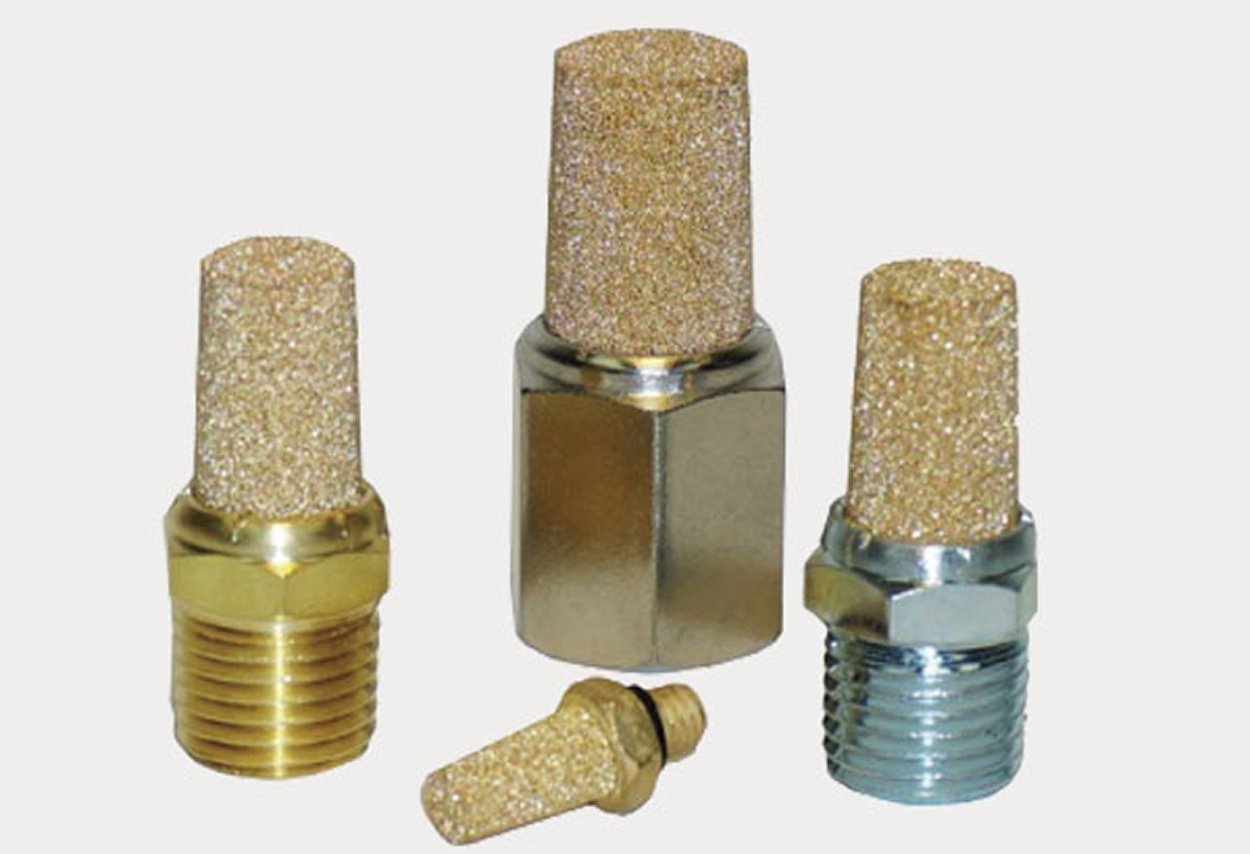
Real-world reference Representative sintered bronze muffler
Sintered Bronze Muffler — representative product photo
Why it's needed

Why this matters.

When sintered bronze is the right call, and when to spec something else. Review the points below.

01 · Key point
It drops exhaust 15-25 dBA.

An unmuffled 5/2 solenoid dump hits 90-100 dBA: above OSHA's 85 dBA action level. The porous bronze element diffuses one loud jet across thousands of fine passages and brings the line back under threshold.

02 · Key point
It takes plant abuse.

Metal body handles 35-300°F, dropped tools, guarded contact, and the oil-mist-plus-dust of a typical atmosphere. The default that outlasts every other component on the valve.

03 · Key point
It doubles as a port filter.

The same porous network that diffuses exhaust also blocks shop debris, insects, and ambient particulate from being drawn back through the port during the brief vacuum phase after every dump.

04 · Pro tip
Match porosity to the valve Cv.

40 micron is the right call when in doubt. Step to 10 micron for cleaner installs and reverse-flow filtration; step to 90 micron on high-Cv manifolds where standard grade creates measurable back-pressure.

05 · Where not to use
Washdown, marine, chemical vapor.

Bronze corrodes in salt air, sanitizer spray, and chemical atmospheres, and sheds corrosion products back into the air stream. → Switch to plastic-body muffler any time the ambient is corrosive to metals.

06 · Where not to use
Pores clogging faster than PM.

Foundry, cement, grain, or heavy-lubricator duty loads the porous element in weeks, not months. Sluggish valves are the late symptom. → Shorten the PM cadence rather than fighting the source, bronze is cheap enough for monthly swaps on dirty manifolds.

07 · Where not to use
Weight-sensitive moving sub-assemblies.

EOAT, gantries, and high-speed pick-and-place pay a cycle-rate penalty for every gram of muffler mass. → Switch to plastic for cost and weight on moving manifolds where the duty is light and exhaust stays cool.

Key selection criteria

What we need to spec it right.

From the machine spec sheet to the part number. Answer what you know, leave the rest blank, and send.

04Choose your priority  ·  core differentiator

Whatever your lever — performance, value, or price — SPC has the right brand.

Pick the priority; the quote desk handles the cross-reference.

01 Performance 1 brand
02 Value 2 brands
03 Price 1 brand
Where it's used

Industries served.

Each industry below uses this product across the listed areas. Open an industry to see how it fits the rest of its system.

Also applies to 500-2,000 sintered-bronze mufflers · 6-month PM · Compressor enclosure venting · unload valve (vents the compressor head between load cycles) · Pneumatic test benches in service shops · Plant-air drain and blowdown vents

Install · 6 critical steps

The things that matter on the first install.

Step 01
Match the thread to the valve exhaust port
M5, 1/8", 1/4", 3/8", 1/2" in NPT (US tapered) or BSPT (British/European tapered), extending to 3/4" and 1" on larger industrial bodies. Read the standard off the valve datasheet; NPT and BSPT are NOT interchangeable. Use the female-thread NPTF (NPT for Fuel, the dry-seal variant) only where the port specifically requires it.
Step 02
Use PTFE thread sealant tape, never anhydrous pipe dope
2-3 wraps of PTFE (Teflon) tape wound clockwise looking at the thread end. Anhydrous pipe dope migrates into the sintered bronze element from the threaded side and partially clogs the muffler before it goes into service. PTFE is the only acceptable thread sealant on sintered bronze.
Step 03
Hand-tight plus 2-3 wrench turns
Bronze tolerates more torque than plastic but threads still strip if over-torqued, especially on the smaller M5 and 1/8" sizes. Hand-thread until snug, then 2-3 wrench turns. If sealing requires more than 3 turns, suspect damaged threads or a mismatched standard.
Step 04
Orient the diffuser pattern intentionally on high-flow models
The high-flow diffuser body spreads exhaust in a 360-degree pattern. On crowded manifolds, orient so the dominant exhaust direction doesn't blow onto an operator's standing position, an electrical enclosure, or a sensitive instrument. On dense manifolds with mufflers spaced inches apart, alternate orientation to reduce mutual exhaust interference.
Step 05
Match porosity grade to the duty
Standard general-purpose porosity is around 40 micron. Use the finer 10-micron grade where reverse-flow filtration matters (instruments, cleaner installs). Use the coarser 90-micron grade on high-flow valves where standard grade creates measurable back-pressure. When in doubt, 40 micron is the right call.
Step 06
Set the replacement cadence at install in the MRO system
Record thread size, body style, porosity grade, manifold location, and count installed per machine. Set the next replacement 6-12 months out by environmental duty (cleaner installs at 12 months, dustier or oilier at 6 months). Replace as a manifold set at PM, not reactively per-failure.
Troubleshoot · top failures

Most returns trace to one of these causes.

Symptom
Most likely cause
Fix
Valve actuation slowing or sticking on a manifold
Clogged mufflers restricting exhaust flow. The valve can't dump trapped air fast enough, so the actuator return stroke slows and the valve appears sluggish. Almost always the muffler, not the valve. A manifold's mufflers age together, when one is clogged, the rest are within weeks of the same fate.
Replace the full set on the affected manifold, including the visibly slow valve. Document the install date on the customer's PM system so the next replacement lands on the calendar. If the symptom returns within months, the duty is dirtier than the cadence assumes, shorten the interval rather than switching muffler lines.
Audible whistle or hiss from the muffler face
Partial-clog channeling exhaust through a small portion of the porous surface, OR the sintered element is mechanically damaged (cracked from impact, distorted from over-torque at install).
Replace the muffler. The whistle is the early acoustic warning, catch it here, before the connected valve starts to slow. If multiple mufflers on the same manifold are whistling, the whole set is at end of life.
Oil weeping from the muffler face
Upstream lubricator (the "L" in the FRL, meters atomized oil into the air line for older lubricated tools) metering oil into the system. Oil passes through the valve and sheds visibly along the porous bronze body. Indicates the lubricator is over-oiling OR the line is downstream of equipment that doesn't need oil at all.
Verify whether the system actually needs the lubricator (modern non-lubricated valves don't). If required, dial the drip rate down. Don't solve oil-bleed at the muffler, it's an upstream issue and the muffler is the visible symptom.
Muffler clogging faster than expected (months instead of a year)
Dusty plant atmosphere (foundry, cement, grain, woodworking), heavy lubricator over-oiling, dirty compressor intake feeding the manifold, or the muffler is mounted where it eats foot-traffic dust on every inhale-stroke.
Shorten the replacement cadence rather than fighting the source, bronze mufflers are cheap enough that monthly replacement is acceptable on a dirty manifold. For systemic dust loading, address upstream (compressor intake filter, dryer, oil carryover). For local dust, relocate the muffler or fit a high-flow diffuser body with more porous area.
Cracked or distorted muffler body
Over-torque at install (the threaded brass or steel body cracks at the thread root), mechanical impact, thermal stress (extreme cycling between cold ambient and hot exhaust), or external corrosion (washdown chemicals attacking the bronze or housing).
Replace the muffler. If over-torque, retrain on hand-tight + 2-3 wrench turns. If impact, evaluate guarding around the install. If corrosion or washdown, this is the wrong application for bronze, switch to plastic-body in this location.

Get the right sintered bronze muffler on quote in 24 hours.

Send us the application — a specialist routes you to the correct tier with a configured part. Lead-times and pricing returned within one business day.

Open quote engine ↑