DISTRIBUTOR-FIRST SUPPLY PARTNER · SINCE 1999 Live · Pneumatic Automation System

SPC Company
Pneumatic Automation / Control & Valving / Manual & Shutoff Valves / Hand Valve
What it is

Hand Valve

A hand valve is a compact hand-actuated manual valve: a lever, knob, button, or toggle that an operator works directly to turn an air circuit on and off or to switch its direction at the point of use. Unlike a ball valve (which isolates a line for service) a hand valve is a working control: it sits at the workstation as the operator's on/off or directional command for a single device, a blow-off, a clamp, a small cylinder, a vacuum cup, an air tool. The common form is a small 2-way (on/off) or 3-way directional body where the OFF position blocks the inlet and vents the downstream device to atmosphere, leaving it safely depressurized; a non-venting 2-way variant exists where downstream pressure must be held. It is threaded (NPT/BSPP) for hard-pipe or panel mount, the push-to-connect tubing version is a separate product (see PTC Hand Valve). It is the simplest possible local manual control: no coil, no PLC, no electrical actuation. Distinct from its siblings: the mechanical valve is the broader actuator-driven DCV category (foot pedals, palm buttons, cam-rollers, machine-logic sequencing and safety interlocks); the hand valve is the small operator-worked on/off-or-direct-directional control at a single drop.
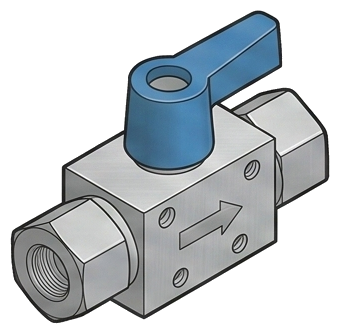
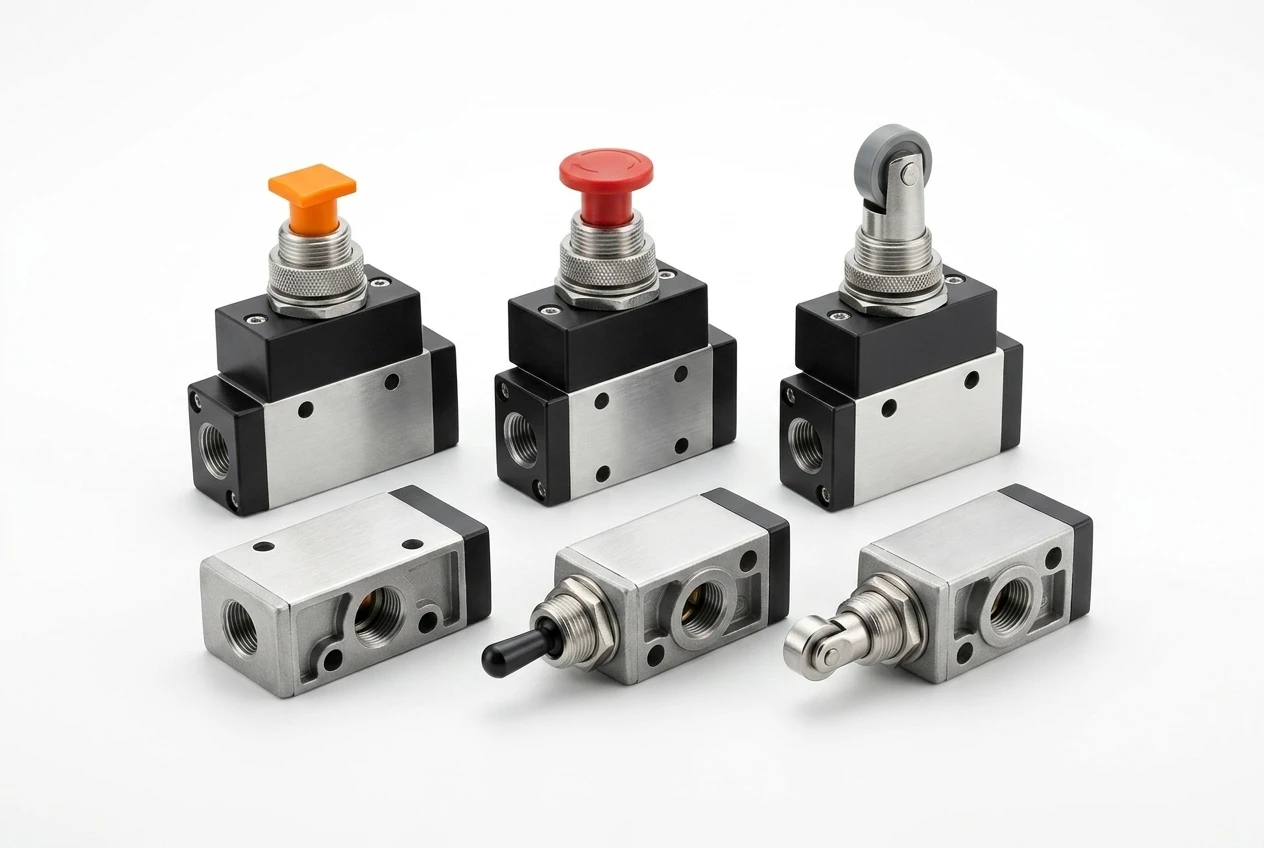
Pictorial Representative hand valve
Hand Valve — representative illustration
Where it's used General Manufacturing
General Manufacturing application
Why it's needed

Why this matters.

When the hand valve is the right call, and when to spec something else. Review the points below.

01 · Key point
A working control, not an isolator.

The hand valve is the operator''s on/off or directional command for a single device at the workstation, a blow-off, a clamp, a vacuum cup. It''s worked constantly as part of the job, not turned once to isolate a line for service. That''s a ball valve''s job, not this one.

02 · Key point
3-way vents the device in OFF.

A standard 3-way hand valve blocks the inlet AND vents the downstream device to atmosphere in the OFF position, the clamp releases, the cylinder depressurizes, the cup lets go. That safe-state vent is the usual reason to pick a 3-way over a plain 2-way. A non-venting 2-way holds pressure when that''s what''s wanted.

03 · Key point
No coil, no voltage, no wiring.

Nothing to match, nothing to burn, nothing to wire. The right call for a single operator drop, a no-power location, a portable rig, or a station where electrical actuation is overkill. Pick spring-return for a momentary command, detented when the operator wants it to stay set.

04 · Pro tip
Match actuator to the operator''s hand.

Hand lever for a positive, visible on/off the operator can see at a glance. Push button for a momentary trigger. Toggle or knob where panel space is tight. The actuator is the ergonomic call; confirm how the operator reaches and works the control before quoting.

05 · Where not to use
Lockable line isolation for service.

A hand valve is a working control with no padlock provision; it can''t be locked off for OSHA lockout-tagout. → Re-spec to ball valve when the job is deliberate, lockable isolation of a line for service rather than operator on/off of a device.

06 · Where not to use
Machine logic, safety, or sequencing.

Foot pedals, two-hand palm-button safety interlocks, and cam-roller sequential logic are the broader actuator-driven DCV category. → Re-spec to mechanical valve for pedal/palm-button/cam actuation and machine-logic duty. The hand valve is the simple operator on/off-or-directional at one drop, not a safety device.

07 · Where not to use
Tunable flow throttling.

A hand valve is on/off (or directional); it''s not built to meter and partial positions are non-repeatable. → Re-spec to flow control valve for bidirectional line throttling, or a speed controller for one-direction cylinder speed at the cylinder port.

Key selection criteria

What we need to spec it right.

From the machine spec sheet to the part number. Answer what you know, leave the rest blank, and send.

Where it's used

Industries served.

Each industry below uses this product across the listed areas. Open an industry to see how it fits the rest of its system.

Also applies to Blow-off and clean-down stations. · Single-acting clamp and ejector control. · Vacuum cup on/off at a handling station. · Local air-tool and accessory gating. · No-power and portable rigs. · Test and setup stations.

Install · 5 critical steps

The things that matter on the first install.

Step 01
Confirm function and OFF behavior against the controlled device
2-way for plain on/off; 3-way directional when the device must vent and depressurize in OFF. Installing a non-venting 2-way where the device needed to bleed down leaves a clamp pressurized or a cylinder extended when the operator switches off; verify the OFF behavior against what the station requires before plumbing.
Step 02
Mount the actuator within the operator's normal working reach and posture
The control is worked repeatedly as part of the job, a lever, button, or knob placed too far forces compensating reach that slows the operator and invites workarounds. Panel-mount valves sit flush at the station face; inline valves go where the hand naturally falls. Set the orientation so the actuator's ON/OFF travel is unobstructed.
Step 03
Plumb the exhaust/vent port clean on 3-way valves
A 3-way hand valve vents the downstream device through its exhaust port in OFF. Don't leave the exhaust open in a dusty or wet station, it ingests contamination into the body. Fit a small muffler or filtered vent where the environment warrants; keep the vent path clear so the device actually depressurizes in OFF.
Step 04
Thread sealant by thread type
NPT = 2-3 wraps of PTFE tape on the male thread in the direction of engagement. BSPP/G seals on the face, no tape on the threads. Don't over-torque a small valve body; a distorted body can bind the spool/poppet and stiffen the actuator.
Step 05
Cycle and verify the safe-state at commissioning
Work the actuator through its full travel and confirm ON delivers air to the device and OFF does what it should, blocks (2-way) or blocks-and-vents (3-way). On a spring-return valve, confirm it returns fully to OFF when released. On a detented valve, confirm it holds where set across several cycles without drifting back toward center under vibration.
Troubleshoot · top failures

Most returns trace to one of these causes.

Symptom
Most likely cause
Fix
Device stays pressurized after the operator switches the valve to OFF
A non-venting 2-way valve installed where a venting 3-way was needed (most common spec miss), or the 3-way exhaust/vent port is blocked or plugged, or the spool/poppet isn't reaching the full OFF position.
Confirm the valve function against the requirement, if the device must release in OFF, it needs a 3-way that vents. Clear the exhaust/vent port. Verify the actuator travels to full OFF; a partially-actuated spool blocks the inlet without opening the vent.
Actuator is stiff or hard to work
Spool/poppet sticking from contamination, or the body over-torqued at install and distorting the bore, or a corroded pivot on a wet-station valve, or a return spring stiffer than comfortable for sustained operator use.
Clean the spool and bore if accessible; if not, replace, small commodity hand valves are rarely field-rebuildable. Lubricate the pivot. If the return spring is uncomfortably stiff for repeated operation, the station may want a lower-force actuator style.
Valve won't hold its position (detented version drifts back)
A worn or weak detent (ball-and-spring or pin-and-spring) releasing under vibration, or a detented variant mistakenly specified where a maintained design was needed, or shipping/handling damage to the detent.
Verify the part number is the detented/maintained variant. If correct and the detent is weak, replace; the detent mechanism is not reliably field-serviceable on a commodity valve.
Spring-return valve does not return to OFF when released
Broken or weakened return spring, or spool sticking from contamination so the spring can't overcome it, or a detented variant installed where spring-return was intended.
Confirm the variant is spring-return. If the spool is sticking, clean or replace. A failed spring on a small valve is usually a replace, not a repair.
Continuous hiss from the valve at rest
Worn inlet seat leaking through (common after years of contamination), or a damaged O-ring/poppet, or a cracked body from an over-torqued fitting.
Isolate the leak, at the exhaust port (seat passing) or at the body/threads (replace). Fleet-wide leaks point at upstream air quality; check the coalescing filter. Commodity hand valves are typically replaced rather than rebuilt.

Get the right hand valve on quote in 24 hours.

Send us the application — a specialist routes you to the correct tier with a configured part. Lead-times and pricing returned within one business day.

Open quote engine ↑