DISTRIBUTOR-FIRST SUPPLY PARTNER · SINCE 1999 Live · Product System

SPC Company
Performance · SMC Value · AIGNEP
What it is

Lubricator

Compare tiers ↓

The lubricator stage of air preparation sold as an individual modular unit. It meters a controlled mist of oil into the compressed air stream for equipment that requires lubricated air. Air flowing through the unit draws oil from a reservoir bowl and atomizes it; an adjustable drip rate sets how much, and a sight dome shows the oil level so an operator can refill it. The lubricator is the one air-prep stage that is usually omitted. Most modern pneumatic equipment is built for non-lubricated air with self-lubricating internal materials, and a lubricator on such equipment contaminates downstream sensors and product with oil. It is required only for old-style pneumatic tools, impact wrenches, jackhammers, sand rammers, heavy-duty legacy cylinders on older seal materials, and any equipment whose nameplate or spec sheet calls for lubricated air. When in doubt, the equipment's documentation decides. As a standalone unit it adds the L stage to a filter-regulator train or replaces the lubricator on a modular assembly. It is placed last in the air-prep order, after the regulator, so oil mist is added to clean, pressure-set air just before it reaches the equipment.
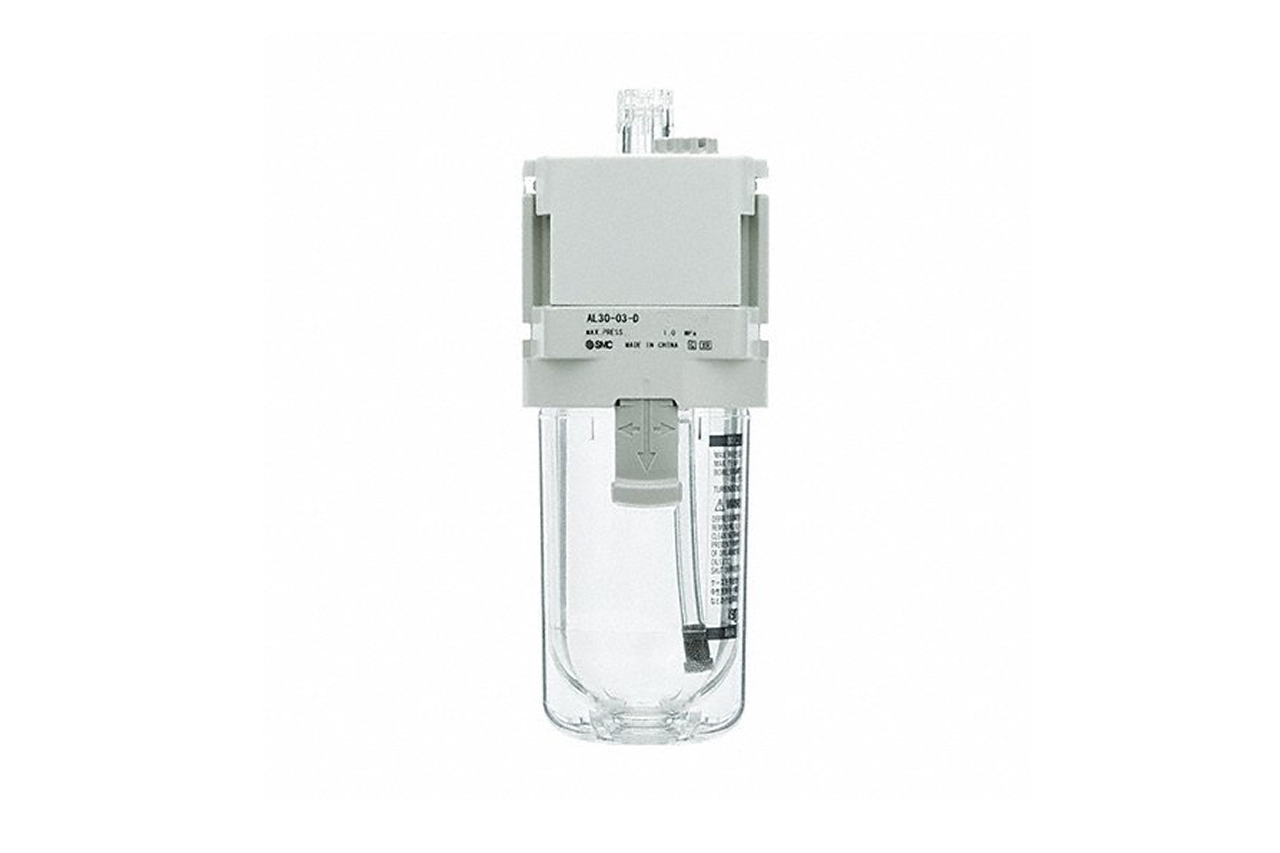
Pictorial Stage-aware drawing
Real-world reference Representative lubricator
Lubricator — representative product photo
Why it's needed

Why this matters.

When the lubricator is the right call, and when added oil creates maintenance problems. Review the points below.

01 · Key point
Required for legacy oiled equipment.

Old-style impact tools, jackhammers, sand rammers, chipping hammers, and heavy-duty legacy cylinders on older seal materials all depend on metered oil for piston lubrication and seal life. Nameplate decides, never default to L.

02 · Key point
Modular drop-in.

As a standalone unit the L adds the lubricator stage to an existing F+R train or replaces just the L on a modular F+R+L without disturbing the filter and regulator. Goes last in the air-prep order, after the regulator.

03 · Key point
Right mist type for the distance.

Standard fog drops out within ~10–15 ft, fine for L mounted near the equipment. Micro-fog (sub-micron mist) stays airborne and carries to distant tools through long distribution runs.

04 · Pro tip
Set drop rate under load.

Sight glass should show 1 drop every 1–5 strokes with the machine actually running, static settings don't translate to running flow. Use ISO VG 32 air-line oil (NSF H1 for food); never motor oil, compressor oil, or WD-40.

05 · Where not to use
Modern non-lubricated automation.

Anything 2010+ runs on PTFE, lip-seal compounds, sintered bronze, added oil fouls sensors and contaminates product. → Re-spec to a filter-regulator (F+R); the L is the maintenance bill, not the fix.

06 · Where not to use
Food contact, pharma, semiconductor.

Oil carryover is a product-rejection event on contact-food lines and contaminates clean-room and lab air. → Omit the L absolutely; quote an F+R with stainless bowl and coalescing element instead.

07 · Where not to use
Upstream of the regulator.

Mounting the L before the R sends oil into the regulator diaphragm and kills it within months. → L goes last in the air-prep order, after the regulator; oil mist is added to clean, pressure-set air just before it reaches the equipment.

Key selection criteria

What we need to spec it right.

From the machine spec sheet to the part number. Answer what you know, leave the rest blank, and send.

04Choose your priority  ·  core differentiator

Whatever your lever — performance, value, or price — SPC has the right brand.

Pick the priority; the quote desk handles the cross-reference.

01 Performance 1 brand
02 Value 1 brand
Where it's used

Industries served.

Each industry below uses this product across the listed areas. Open an industry to see how it fits the rest of its system.

Also applies to Pneumatic impact tools & hand tools · Heavy-duty legacy cylinders · Sand blasting & abrasive equipment · Paint spray guns (lubricated type) · Sand & bead casting machinery · Rotary air motors (legacy oiled type) · NOT for

Install · 6 critical steps

The things that matter on the first install.

Step 01
Place it LAST in the air-prep order
The L goes downstream of filter and regulator; oil mist is added to clean, pressure-set air just before it reaches the equipment. Installing the L upstream of the regulator destroys the regulator diaphragm with oil residue.
Step 02
Mount vertically with the bowl down
Tilted = oil pickup tube misses the reservoir = no lubrication. The sight dome must be visible from operator standing position so refill cycles get noticed before the unit runs dry.
Step 03
Match the flow arrow
Stamped on the body. Backwards install = no oil pickup = no lubrication, and the L looks like it's broken when it's actually just installed wrong.
Step 04
Fill with the right oil grade
Air-line lubricating oil only: not motor oil, not compressor oil, not WD-40. Food-contact equipment requires NSF H1 grade. Mismatched oil destroys downstream seals and voids equipment warranties.
Step 05
Set the drip rate under load
Adjust with the machine actually running. Sight glass should show 1 drop every 1-5 strokes for most equipment, follow the equipment maker's spec, not a guess. Static drip-rate settings don't translate to running flow.
Step 06
Document the refill cadence at the machine
The next operator won't know it has an L unless you make it obvious. Tag the unit with oil type + refill interval; otherwise it runs dry within months and the lubed equipment fails for a $5 reason.
Troubleshoot · top failures

Most returns trace to one of these causes.

Symptom
Most likely cause
Fix
Lubricator bowl full, but no oil reaching equipment
Drip rate is set to zero (most common, operator turned it down), pickup tube is clogged or air-locked from contaminated oil, OR the unit is mounted backwards/tilted so the pickup can't draw from the reservoir.
Check drip rate under running flow first (it's almost always this). If correct, drain and refill with fresh air-line oil and verify mount orientation, if those don't fix it, the pickup assembly needs cleaning or replacement.
Oil reaching equipment but in droplets, not mist
Wrong lubricator type for the distance: standard (fog) L installed more than ~15 ft from the equipment lets heavy droplets fall out in the line before reaching the machine. Or the equipment is downstream of a sharp bend that's separating the oil out.
Swap to a micro-fog L for long runs (sub-micron mist stays airborne). For sharp bends, relocate the L closer to the equipment or redesign the run.
Polycarbonate bowl cracked or hazy
Synthetic compressor oil or solvent contamination from upstream. Polycarbonate is chemically incompatible with most synthetic lubricants; a crack-and-blow under pressure is a real safety risk.
Replace with metal or stainless bowl variant immediately. Audit the upstream compressor oil.
Oil consumption rate suddenly increased
Drip rate got turned up (check first), OR downstream equipment seal failure is sucking oil through unnoticed leaks.
Verify drip-rate setting hasn't drifted. If correct, walk the downstream run looking for leaks or active seal failures; oil consumption is often the first symptom of a cylinder rod-seal failure.
Equipment downstream contaminated with oil after L install
The equipment was never spec'd for lubricated air, L was sold by reflex on modern non-lube equipment.
Confirm against the equipment spec sheet. If non-lube, remove the L, switch to F+R, and clean the downstream sensors and valves.
Sight dome fogged or cracked
Hairline cracks from temperature cycles or impact, OR the dome is at end of life.
Replace the sight dome, cheap part, big maintenance value. Operator can't see oil level otherwise and the L runs dry.

Get the right lubricator on quote in 24 hours.

Send us the application — a specialist routes you to the correct tier with a configured part. Lead-times and pricing returned within one business day.

Open quote engine ↑